 Downtown Miami
Relational Aesthetics and Symbolic Interactionism: An Approach to the Experimental Work of Ron Chávez
By Abdel Hernández San Juan // Photographs by: Jenifer Cusumano @lacusugrafia Special thanks to: La Escuelita de Ale
Contents
- Preamble: From Encounter to Interdisciplinarity
- Entrance: Other Boundaries of Anthropological Theater
- From Gesture to Intramundane Relations
- The Critique of the Canon and the Experimentality of Reality
- From Kinetic Participation to Eidetic Structuring
- From Transavantgarde Desacralization to Irony, Parody and Humor
- Exit: Constellations of Ron Chávez and Huellas del Arte
- General Bibliography
Preamble: From Encounter to Interdisciplinarity
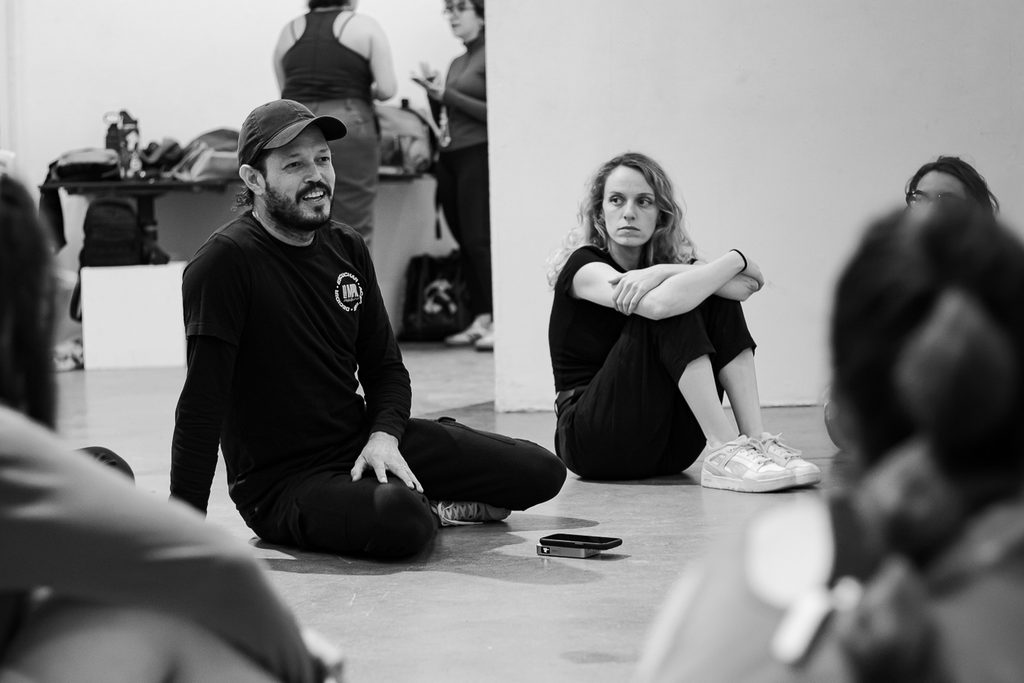
The writing of this essay had a starting point that, in keeping with Ron, I would not want to neglect here, and I bring that process into the essay itself because of its relevance. I am referring to two encounters, above all the second, which unfolded as a dialogue I held with Ron an hour before the master class he gave last week at the Centro de Arte Los Galpones in Caracas, thanks to the invitation, initiative and coordination of Alejandro Rojas, curator, visual artist and editor of the continental project “Huellas del Arte.”
This dialogue was above all a virtuosic and sophisticated talk by Ron on his concept of the stage, of the actor, of the psychophysical process of symbolization that his concept of improvisation involves, on pertinence as the concept at the center of his work, and on the differences between his sense of the stage and that of psychodrama, among other topics. It was unforgettable both for me and for the Italian archaeologist Alessandro Morganti, who accompanied me in the experience. Ron’s very high and highly eloquent level of reflection, his self-reflective capacity to abstract and explain the concepts and principles that form the backbone of his conception of the stage, the actor and the work, allowed us to understand that to approach his work without an interdisciplinary perspective would be to fail to understand it.
Entrance: Other Boundaries of Anthropological Theater
The concept of improvisation is crucial in experimental genres of art such as Abstract Informalism in the painting of high modernism, or the so-called postwar post-avant-garde, in the psychic automatism of Surrealist painting and poetry in the early twentieth century, and in general in much Expressionist, Neo-Expressionist and abstract art, as well as in musical genres such as jazz. It has also acquired relevance since Grotowski, Eugenio Barba and the so-called Anthropological Theater, above all in the training of actors, where it lies at the center of an anthropological and ritual understanding in the theory of actor training.
What is anthropological in this understanding of actor training comes from its appeal to primal aptitudes, capacities and instincts in our psychophysical makeup, the so-called pre-expressive languages. These are thus linked, in one sense, to the earliest stages of culture: the very assumption, archaeological if you will, that culturally human beings first communicated with gestures and sounds before the appearance of spoken language. They are linked as well to childhood in the evolution of life, the fact that we are first gesture and extraverbal sound, still without recourse to words. And they are related to the process by which identity is formed, and to the relational difference between the inner self and its evolution in relation to the other or to social others: we differentiate ourselves to the same degree that we internalize our similarities to and differences from others, as Jean Piaget explained in “El Aprendizaje en los niños.”
Stanislavski’s was a mimetic understanding of the actor’s training, in which one learns to be an actor by incorporating all at once the plots of a society already formed in its representations and ideologies, just as in the fine arts the artist is supposed first to master the laws of realist representation in order to break with them later. In contrast stands this other idea: that the actor must first know himself, his pre-expressive and extraverbal gestural attitudes, even onomatopoeic sounds still without words; must enter his own universe of gestural expression while not yet representing plots or stories; and must know his relational and associative potential to interact, react, adapt, become ductile and interpret in relation to others. These are among several principles that the gestural character of improvisation brings with it in its relation to time and image, and they have given primacy to the concept or notion of the free exercise.
With the experimentality inherent in the notion of the exercise, at the base of actor training, these exercises rely on certain guidelines as a starting point for developing bodily, gestural or guttural improvisations in which actors test their capacity to find quick responses, shed inhibitions, open outward, and relate to other bodies, gestures and interactive expressions. All of this has underpinned an idea of improvisation that, born of the methods of actor training, has led to new modalities of improvisational theater, a sui generis kind of theater in which, in a certain way, the training itself is what becomes the work. But to turn training into the work is at the same time to validate the creative process, that is, to bring to the foreground a temporality of experience and of lived experience which, because it precedes the work or is an instrumental means directed toward it, tends habitually to be excluded from the work as a result. The resulting work thus becomes a scenic memory that externalizes that earlier process or puts it on stage.
Everything said above lies at the base of, and structures from within, the kind of experimental stagings that have long characterized the work, as director, author and actor, of the distinguished and acclaimed Venezuelan artist Ron Chávez. His work is one of the most notable expressions of process art today, understanding this concept from the standpoint of the performing arts and theater, and it represents, on the continent, other boundaries within the tradition of anthropological theater.
From Gesture to Intramundane Relations
It is true that Chávez’s conception entails a break with, or a farewell to, an idea of the aesthetic whole of the work understood as a pre-established, all-encompassing, totalizing metanarrative, instrumentalized by a preconceived script; it breaks with that uniqueness of the work of art to which Walter Benjamin referred. His theater thus establishes a concept of the aesthetic that is open and relational and that validates the fragment, as already happened in another way in the experimentalist fragmentation of artists such as John Cage, when he made his works from fragments of chance, casual sounds accidentally recorded from reality itself, in aleatoric or electroacoustic music, among other forms that, as we can see in Ron, desacralize in a transavantgarde manner the canon of what we consider a work of art with a capital A. Or else, quite simply, as has also tended to happen with experimental video and film, they renounce the idea of a narrative with its linear or chronological sense of plot, that Aristotelian idea that a dramaturgical whole must have an introduction, a knot, a development and a denouement, in order to explore instead other possibilities that are less representational and more evocative.
With Ron Chávez, then, we are dealing with a modality of ritual and anthropological theater which, despite its intense poetry and its tropological and Symbolist character, does not dissolve into mere exercises in abstraction, as tends to happen with much improvisational theater that turns training into the work. I am thinking not only of Grotowski, Barba and other theater experimentalists whose improvisation exercises, although based on guidelines, become largely abstract: onomatopoeia in place of the word, the dance of abstract forms in place of adaptation to a mode of intersubjective communication shaped by intramundane meanings.
Although Ron’s experimentalism undoubtedly also passes through this moment and includes passages of it, above all where Ron becomes metatextual, that is, where he turns the stage into a visual and bodily reflection on the stage itself, exploring the borders between art and pedagogy, something frequent and among the most outstanding things in his search, it is also true that, like few others, Ron has known how to make this part of a more complex and richer investigation. That investigation also explores how to return this experimentalism of improvisation to the realm of reality, by bringing in the concept of pertinence, rooted in an understanding of reality from the perspective of common sense, what Alfred Schutz called typifications, as a guideline for transforming improvised interaction into principles of intramundane dramaturgical threading. In other words, through the concept of pertinence, Ron transforms the experimental results of an improvisational exercising of gesture, an exercising that in itself involves de-routinizing, de-habituating and rendering movement extra-daily, that is, freeing the actor’s body of the inhibiting stereotypes engraved or inscribed in the muscles like stereotyped histories, into relational guidelines that read intercorporeal, intergestural or intra-actor interaction as symbolic interaction. By way of pertinences, he threads that uninhibited gesturality together with potential senses or meanings that begin to generate micro-plots, or sketches of content, and not only of form or morphology.
Despite these differences from traditional anthropological theater, the anthropological component that persists in Ron Chávez’s theater lies in this: by returning, from pertinence, to an intramundane sense of threads that gives plot to symbolic interactionism and gradually transforms the gestural universe into micro-discourses, it proposes, in a certain way, a journey to the social world as if for the first time. That is, it makes the actor re-enter into relation with his own expressive gestural world as if that world were in a pure state, before being contaminated; and by returning this, via pertinence, to ways of giving sense and meaning, it is as if he emptied the social world of its previous forms and proposed a universe in which we see others again as if we were seeing them for the first time, in which we see the fabric of the interactive, social and cultural symbolic world again as if we had never seen it before, or as if we were seeing it for the first time.
This kind of evocation of a return to a sense of origin, of the first source, of genesis, of the point of departure, makes Ron’s art a unique and original conjunction between a primal concept of the stage and of the actor and another that is, by contrast, symbolically interactive and social. On the one hand, Ron travels to the seed with his work; he proposes a kind of expedition to the principle of earlier germination, to the first or primitive stage, and this makes his concept of the stage anthropological. But then, on the other hand, once the gestures and the world of expression stand there naked, he reconciles them again, through the intergestural and intercorporeal symbolic interaction of the actors, with intramundane meanings that make the stage a fragment of reality, returning to the everyday through pertinence. The concept of pertinence, in fact, the backbone of Ron Chávez’s conception of the stage, is anchored, as I said earlier, in our sense of the world as we see it through common sense. What is pertinent is a world of meanings already shared and previously typified in the universe that relates us to others, a surrounding world to which we have already given meaning. It is what allows us to distinguish, in the micro-action, in how we express ourselves, address others or interpret their expressions with our bodies, which subsequent courses are the pertinent ones and which are not.
In this way, Ron Chávez’s conception of the stage reconciles the primal, purist and extra-daily vision of a prior, first, gestural, pre-expressive body, freed of stereotypes, with a symbolic interaction endowed with prior meanings, which through pertinence immerse that improvisational expressiveness in subsequent courses and threads of sense and meaning. It thus brings together in a single concept the notions of the stage actor in theater and the social actor as we see it in sociology.
It is as if we ran the irreversible time machine backward, in order to rejoin the elements and begin the interaction again. But at the same time, and in this his art differs radically from earlier forms of anthropological theater, it is as if, once communication has been resumed and has been read and interpreted from the principle of pertinence, the theater turned toward generating intergestural, intercorporeal and intra-actor threads around that intramundanity, becoming the meanings of a scene that once again makes the world previously typified or given meaning by experience the true reason for being of his theater, thereby setting itself apart from the usual anthropological theater.
The Critique of the Canon and the Experimentality of Reality
The work of Ron Chávez, unlike earlier uses of improvisation, explores a harmonious reconciliation between that experimental principle of turning training into the work, with its parameters (the validation of the creative process as an experience more important than the idea of a work closed in on itself, and the turning of the work into something open and relational, in favor of lived experience or associative and interpretive polysemy), and an idea of interaction with the spectator that becomes so important that it even transforms the essence of the work itself, returning in a new way to a certain idea of reality.
Instead of a representational realism, where we speak of realism in reference to the production of an effect of reality through the illusion of language, Ron’s work refers not to the representation of reality but to reality itself, which enters the work transformed or turned into an experimental idea of reality.
From Kinetic Participation to Eidetic Structuring
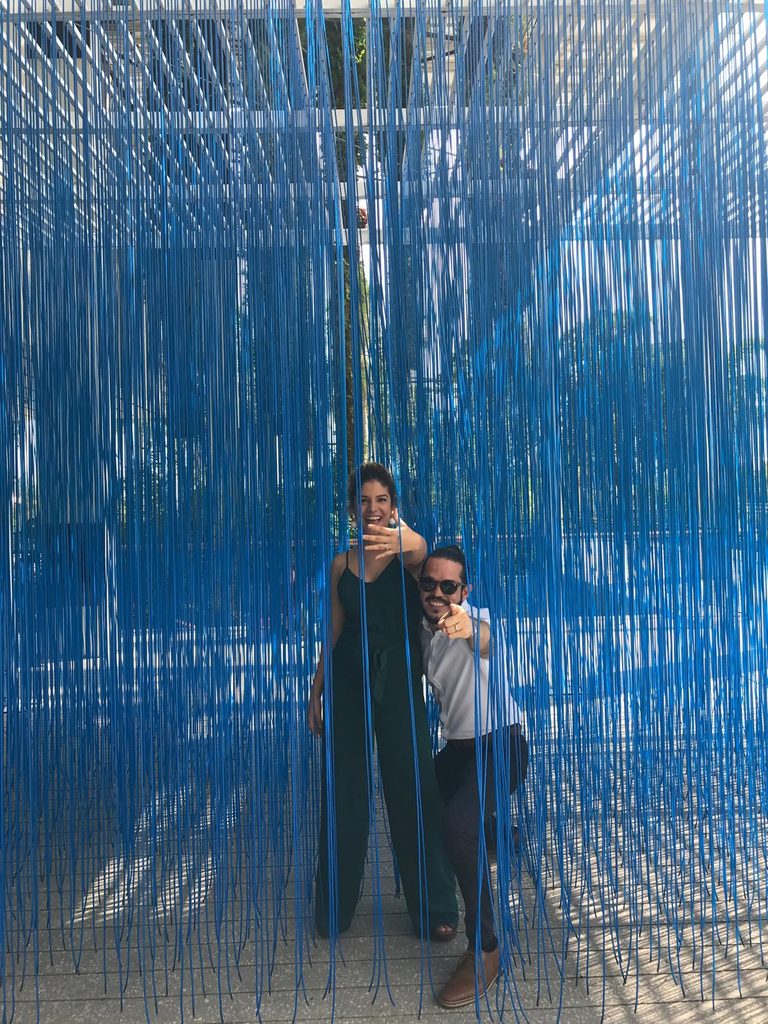
There are, however, things that make Ron Chávez’s theater unique and original in several senses, bearing in mind that, according to Chávez himself when he speaks of his work, even the very concept of theater is called into question or made the object of reflective inquiry. One of them is the way in which, in his work, both alone, in his monologues, and in pieces developed under his direction in group form, the spectator’s participation ceases to be a mere conceptual datum or a mere play on the idea of participation and becomes the very principle that structures the contents of his theater. In one photograph, quite allegorical and representative of Ron’s work, Ron and his partner, who is also a visual artist, appear inside a Penetrable by Jesús Soto. Now, although it is true that the importance the concept of spectator participation comes to have in Ron’s work has its starting point in the pioneers of this in Kinetic art, above all Soto, even in Soto and the Kinetic artists that participation, although, as in Ron, playful and linked to the idea of the game, in which it is the spectator who makes the work, is still abstract. It is more an idea of participation as a concept than a true immersion in participation itself on the part of the author or director, such that the work itself comes to be filled with contents drawn from the reality of that participation. Seen from this perspective, I would speak, in Ron’s case, of a modality of symbolic interactionist theater, taking this concept not from aesthetics or art but from sociology.
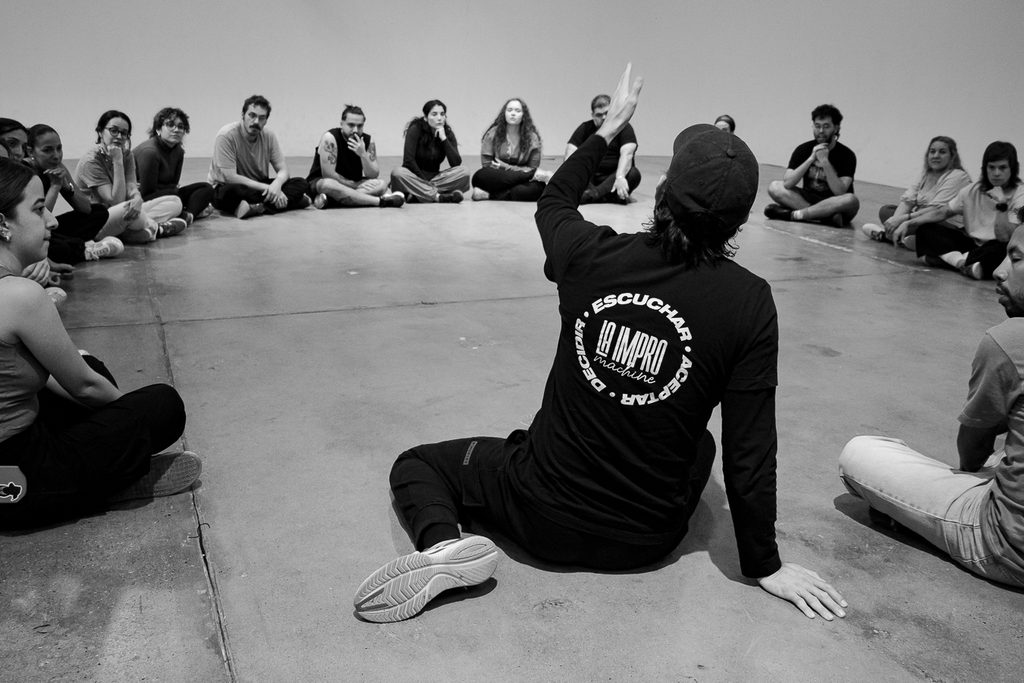
As in the phenomenological or interpretive sociology of the Austrian philosopher Alfred Schutz, Ron’s exploration of the participation of spectators, built around an improvisational concept of the process of aesthetic gestation, has at its center, as I said, the concept of pertinence, in everything that links this concept to common sense. And as in the sociology of George Herbert Mead, the father of symbolic interactionism, Ron’s work has at its center not only the symbolism derived from an interaction with the spectator that is itself symbolic, and also a way of admitting into the work reality itself, turned into the experimentality of an idea of reality, but also the exploration of a beyond-the-borders. These are no longer only the borders between theater and primal ritual, where almost all earlier anthropological theater ended up, but also borders with, in Ron’s words, psychodrama on one side, and on the other, we would add, precisely in light of the caveats Ron stresses, that unlike psychodrama his work is not at all occupied with or centered on therapeutic questions, as I suggested earlier, a certain sociological vision of the concept of the actor that wants to see as equivalent the concept of the actor on the theatrical stage and the concept of the actor as we understand it in sociology.
In fact, Ron’s art does not involve, as I said earlier, a mere playful participation in which the spectator completes the work by playing, as happened in Soto. Rather, the experimentality of reality that the work itself fosters turns the spectator of the work into a social actor, or calls, summons and provokes him as one, even when the entry of his reality into the work transforms that reality into experimentality within the artistic and aesthetic symbolism of the work. Ron’s works thus themselves generate a symbolic interactionism which, recognized and respected within the artistic and aesthetic limits of the work that emerges, brings the spectator face to face with himself around that reality, to abstract and reflect.
His work explores new passages between the spectator’s kinetic experimentation and eidetic construction, since the spectators, as much as the actors, become a condition of eidetic structuring. That is, the works themselves are not only completed by the spectators in the sense that they interpret them or penetrate them with their bodies, nor merely because the work is addressed to them, as in Kinetic art; rather, the very genesis of the work, of its contents, results from the eidetic improvisation of the spectators turned actors, who in fact ideate, generate and engender.
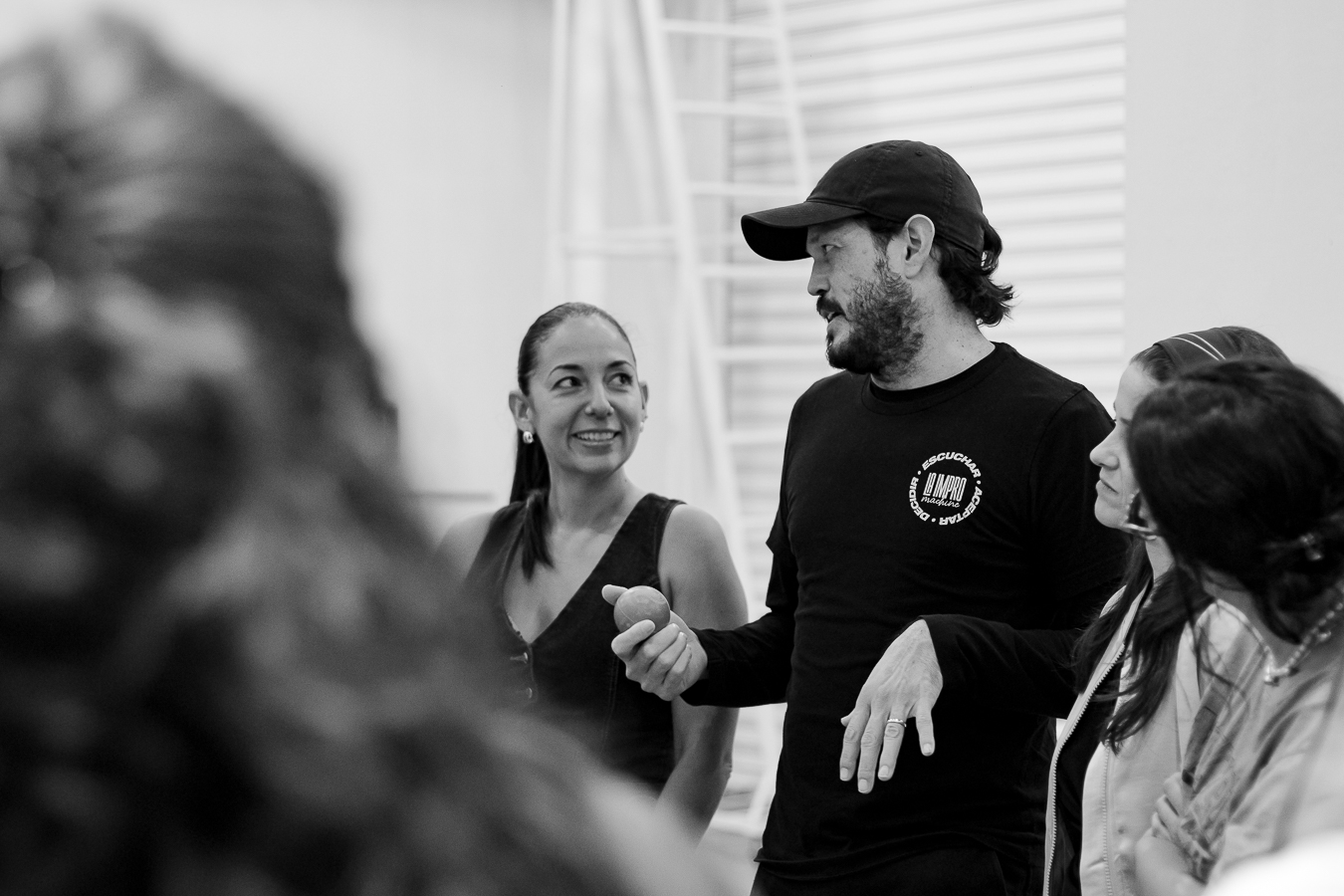
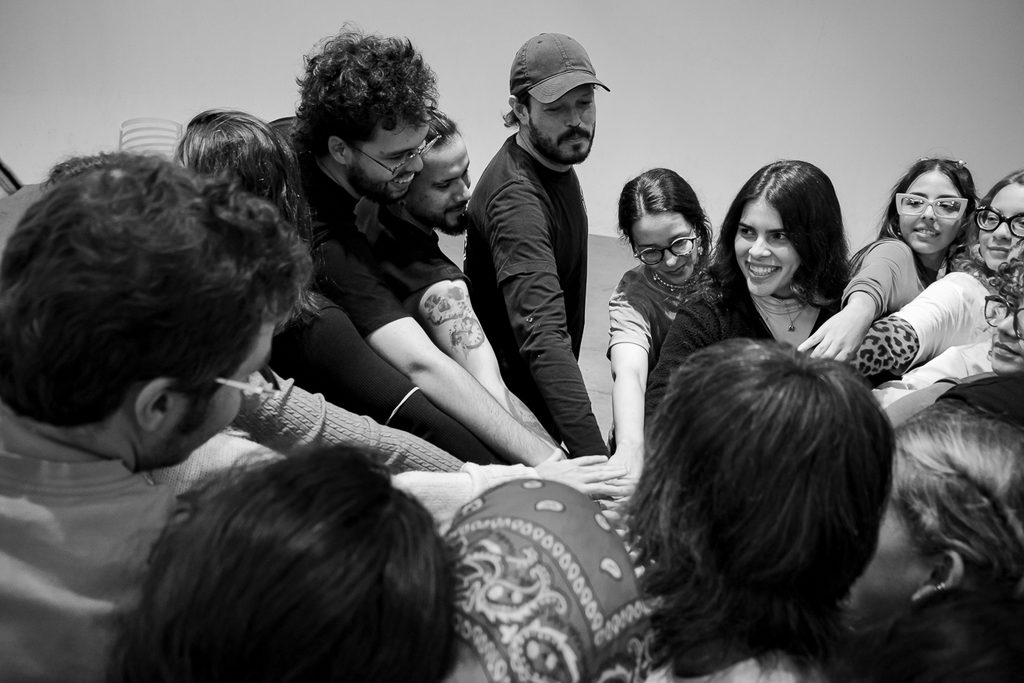
This recurs in Ron’s monologues as well as in works with members of his theater group; or else, quite simply, the spectators literally become actors, as often happens in Ron’s workshops, of which those developed from “Huellas del Arte” are the best example.
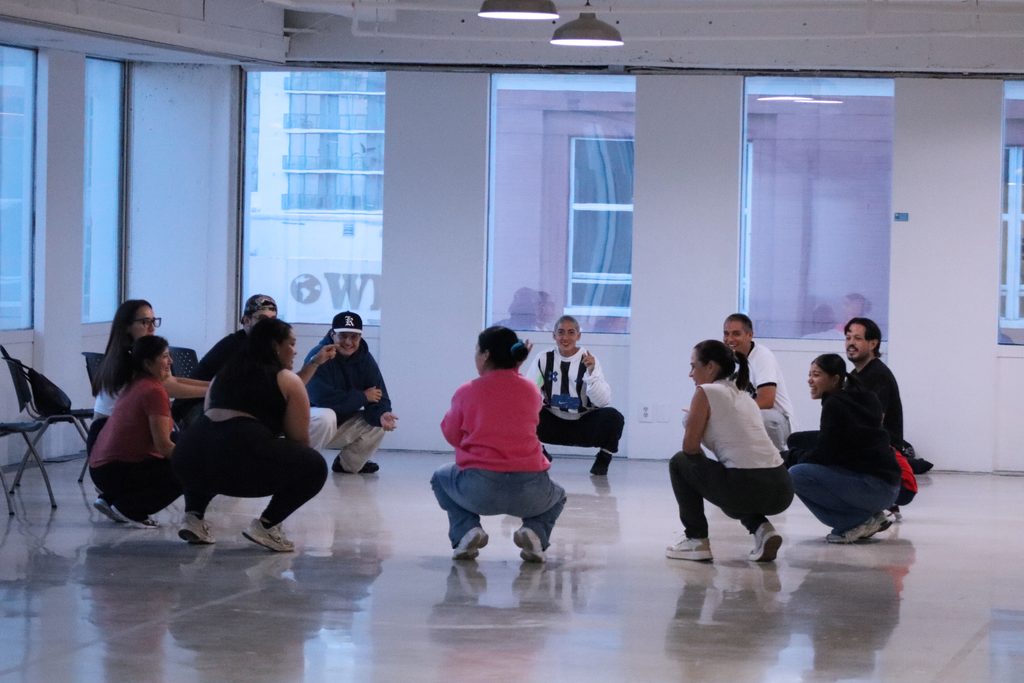
From Transavantgarde Desacralization to Irony, Parody and Humor
Notions such as irony, parody and humor naturally acquire a significant primacy or relevance here, not only because improvising with these symbolic interactions sometimes yields surreal results with elements of a real experience lived in situ, which provoke humor and laughter, but also because there is an aesthetic intention in Ron to make use of all the resources that humor can introduce, coloring the pieces and filling them with contents pertinent to the common-sense universe of experience, while at the same time parodying or ironizing with the resources of humor within the pieces. This outstanding combination of highly experimental elements of avant-garde art and humor is not exclusive to Ron. We find it, in fact, in other refined and, like Ron, equally sophisticated explorers of humor in contemporary art: from a group such as the Argentines Les Luthiers, through transavantgardists of an intentional bad music such as the Uruguayan Leo Maslíah, the Cuban Virulo, or, in the visual arts, the Cuban Lázaro Saavedra, not excluding emblematic figures of humor from a Chaplin or a Cantinflas, through a Woody Allen, to the most refined Symbolist humor of a mime like Marcel Marceau. There is a continental and universal tradition of refined artists who, like Ron, have raised the ironic, parodic and even ethical elements of humor to the most elaborate and refined stage of art.
Ron Chávez’s work also stands out within this latter tradition, being in its own right one of its most significant young exponents today in Venezuela and across the continent.
Exit: Constellations of Ron Chávez and Huellas del Arte
Ron Chávez’s presentations at “Huellas del Arte,” the cultural space directed, founded and edited from Miami by the Venezuelan visual artist and curator Alejandro Rojas, have been emblematic and representative of everything said above. Especially notable is the way in which, from “Huellas del Arte,” owing to the community focus of this project, Ron has been able to explore workshops not only with theater actors from his own group or in spaces exclusively devoted to that purpose, but also with members of the community at large, moving his explorations beyond the borders toward people of other professional backgrounds, and testing the reach, not only pedagogical and propaedeutic but also communicative and expressive, of his concept of stage improvisation. But one of the things that most caught my attention on this occasion, with regard to Ron’s master class at the Centro de Arte Los Galpones and his earlier presentation at Fedecámaras, in Caracas a week ago, is the symbolism of the fact that this metatextual and meta-empirical presentation by Ron Chávez, the foremost exponent of a processual conception, or of process art, in Venezuelan art, took shape in one of the most outstanding centers of contemporary experimental art in Caracas today.
The Centro de Arte Los Galpones was, in fact, in the nineties nothing other than a cluster of artists’ studios where exhibitions as such were not held. I remember it because I visited several times to meet the distinguished Venezuelan artist Ernesto León in his studio, during my time as curator of Venezuelan art at the Museo de Artes Visuales Alejandro Otero in La Rinconada.
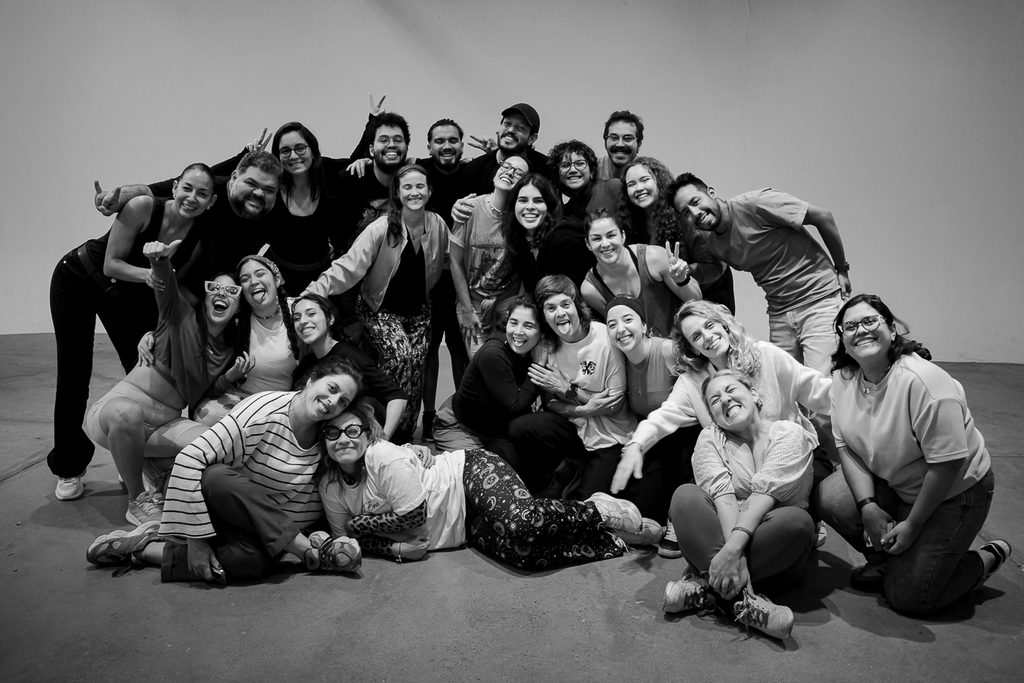
Thus, while Ron Chávez’s master class discoursed rigorously on the experimentality of improvisation, exhibitions were unfolding around it in which improvising is the backbone of the aesthetics. Notable in this regard is an excellent group show curated by Jose Luis García, with a text by Daniela Dias Larralde, relevant above all for the way it transforms the concept of museography into an experimentation with the principle of installation beyond the authorial limits of installation as a genre, toward its anthropological-experimental possibilities, with works by important Venezuelan artists such as Ricardo Benaim, Alirio Palacios, Carlos Quintana, Luis Romero, Nela Ochoa, Madalena Fernández and Milton Becerra, among others.
There was also an exhibition titled “Una Sensibilidad aparte,” which combined and treated ceramics and painting together, with a text by Jose Vicente Enríquez and works by distinguished artists such as Cipriano Martínez, Claudio Perna and Gerardo Rosales, among others.
An exhibition titled “Horizontes” by Richard López, at the Cabinet gallery, largely centered on the relation between landscapes and land art with a sense at once urban and natural, was also on view. And finally, not without stressing here, or returning to, the concept of pertinence as Ron Chávez brilliantly discussed and set it out in his remarks before his master class, there was an exhibition curated by the distinguished curator María Luz Cardeñas focused on the work of Jose Gregorio Grateron, discussed by María Luz as a research process, an aesthetic that somewhat recalls the gesturalism of Basquiat but from Latin American perspectives that María Luz elucidates and explains in her words. The fact that that cluster of warehouses would later become an art center made up of several galleries, cafés, auditoriums and weekly and monthly programming is in itself, like the art of Ron Chávez, a testimony to the ever larger territory that process art is gaining in the sociocultural life of contemporary art. Turning into exhibition spaces clusters that were once only studios where artists experimented with their creative processes is something that tends to be ever more frequent in the art world today. Diverse Works in Houston, Texas, is a similar example: it transformed old train warehouses adjoining downtown into artists’ studios, in whose habitat Diverse Works then arose. So are the Santa Monica Art Spaces in Los Angeles. These last two spaces, although orbiting mainly around the visual arts, have also become spaces for exploration beyond the borders between the arts, making room for experimental theater, staging and different forms of performance.
I am thinking in this regard, beginning with Florida, where Ron Chávez and his wife reside, of stage artists such as the Cuban-born theater director and painter Víctor Varela, author of works such as “La Cuarta Pared,” who appeared at the Los Angeles arts festival in 2001 with a work on Japanese gardens at the Japanese cultural center, and another developed around the principle of the fan at the Frida Kahlo art house; of the anthropological theater of Fernando Calzadilla and Elaiza Irrizarry, developed over many years from Miami, although more recently they have moved to Valencia, Spain; and of the street theater of the Cuban-born theater scholar Roberto Salas San Juan, who has also given relevance in his theater to the Symbolist idea of the mime and to certain principles of the circus.
Beyond Florida, at Diverse Works in Houston, I think of artists such as the German Johannes Birringer, the Mexican Angeles Romero and the Costa Rican Elia Arce, and in California of the Colombians Heidi and Rolf Abderhalden at the Japanese cultural center, or, in Santa Monica, California, of Arce herself and other colleagues of hers such as Daniel Brazel, among others.
General Bibliography
Angelini, Surpik & Hernández, Abdel. Art Lies, Volume 28, Fall 2000, periodical, 2000; Houston, Texas: University of North Texas Libraries, The Portal to Texas History, View on The Portal to Texas History
Birringer Johannes, Theater, Theory, Postmodernism, Indiana University Press
Barba Eugenio y Nicola Savarese. El arte secreto del actor. Diccionario de antropología teatral, Editorial Artezblai
Damián Gutiérrez Hermes, Dramaturgia de la improvisación Universidad Complutense de Madrid, Filología
Rosales Angeles Maria, Teoría del Gesto y Contemporaneidad Teatral, Digital Commons, Connecticut College, https://digitalcommons.conncoll.edu/cgi/viewcontent.cgi?article=1256&context=teatro
Pavis, Patrice. El teatro y su recepción: semiología, cruce de culturas y postmodernismo, Criterios, 1994
© Abdel Hernández San Juan
Translated from the Spanish original.